PLOTLINE
In a small Welsh mining village a man emerges from the disused colliery covered in a green fungus. Minutes later he is dead. UNIT, Jo Grant and Doctor Who in tow, arrive on the scene to investigate, but strangely reluctant to assist their inquiries is Dr. Stevens, director of the local refinery, Panorama Chemicals.
Are they in time to destroy the mysterious power which threatens them all before the whole village, and even the world, is wiped out by a deadly swarm of green maggots?
COMMENT
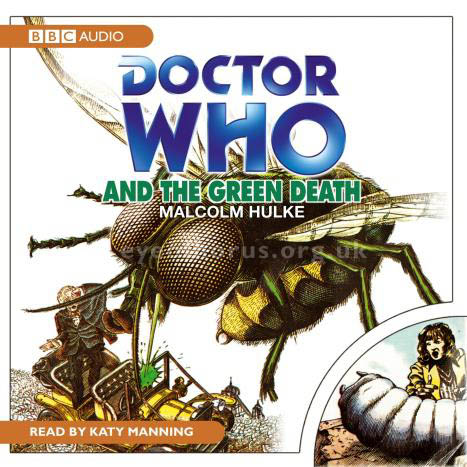
Malcolm Hulke's iconic 1973 (published in 1975) ecology tale, DOCTOR WHO AND THE GREEN DEATH is, unsurprisingly, allocated by BBC AUDIO to another icon. Katy Manning. And it is an extra-ordinary choice, and, like a recently hatched maggot, ravenously engaging, thoroughly entertaining breathing new life into this DOCTOR WHO CLASSIC SERIES "classic".
However, whilst the story steadily unravels - leading to two stunning denouement (the massacre of the maggots and the extermination of BOSS) - it is not for the faint-hearted or animal lovers:
Instinctively it arched its back, heaving against the walls of the egg, and then, suddenly, the egg cracked open. The maggot lay exhausted from its efforts and then it sniffed sharply. It was experiencing a new source of energy. Oxygen in the air around it. It wriggled its little body and realised it was quite strong. It also realised it was very hungry, and now it had to find its own food. It raised its head over the edge of the tray and sniffed again. It could smell that somewhere in this room was food. Somewhere low down.
It heaved itself over the edge of the tray and wriggled to the edge of the table. Below was an enormous drop but the desire for food made it forget all danger. It rolled itself of the table, fell through space and finally hit the floor. The bump temporally stunned its nervous system but it had no bones to break. After a moments pause it raised its head and sniffed again. It wriggled as fast as it could go to the source of the food smells - a hole in the skirting board.
Something with floor legs ran across the floor and went into the hole. The maggot watched fascinated and ravenously hungry but instinct told it not to move. It remained absolutely still despite the knoring pangs of hunger in its digestive system. Then a little head looked out from the hole, tiny eyes regarded the inert maggot, and whiskers twitched. Cautiously, the mouse came out on tip toes, watching and sniffing as it approached the huge object lying still on the floor. It was, the mouse thought, something that could be eaten for it too was hungry.
The mouse went up to the face of the maggot and then the maggot struck. Its jaws opened and the mouse was killed instantly.
Ouch. Now, you can see why Hulke's masochistic maggot did not make it onto the screen, and, through revisiting this audio-novel, both new & older fans will view THE GREEN DEATH with a new perspective.
In many ways, this new unabridged reading (aided by special effects, voice treatment - Manning's interpretation of BOSS is chillingly malevolent - and music) is "An audience with Katy Manning". A one woman tour de force demonstrating an entertaining depth of performance that makes four hours speed past exponentially.
Of course, Manning delivers a poignant reading - it was her final DOCTOR WHO story - that aurally delineates the key & minor characters (like the welsh miners) with distinctive flair and elocutionary precise.
The finale, seeing the Doctor spewing the anti-maggot fungus across the writhing slagheap is thrilling and wonderfully punctuated by Manning's swagger-stick waving Brigadier remonstration; "We've done it! They're dying off like.like maggots!" Fantastic.
BBC AUDIO's production captures the essence of the CLASSIC SERIES that will the Doctor's new 21 st century fans demanding more of the same (Pertwee's DOCTOR WHO AND THE TIME WARRIOR is due in November).